Air that is "within the standard" today will,
once the rules change, soon exceed it several times over
Air pollution is no longer just a public health issue — it is also a growing legal and financial risk for local authorities.
Health impact across age groups
Avoidable deaths (PM2.5 + NO2) — selected Polish cities
| City | Average annual concentration (µg/m³) | Air meeting WHO guidelines | Cleanest air in Europe |
|---|---|---|---|
| Upper Silesia (GZM) | 41.7 | 1,739 | 2,593 |
| Warsaw | 46.7 | 1,494 | 2,174 |
| Kraków | 38.1 | 568 | 856 |
| Łódź | 39.5 | 538 | 953 |
| Wrocław | 35.9 | 388 | 661 |
| Poznań | 40.8 | 243 | 482 |
The victims of poor air quality are not only a personal tragedy, but also a huge burden on budgets and a serious social problem
Stricter standards — Ambient Air Quality Directive (from 1 January 2030)
Source: Europe's air quality status 2022, EEA| Parameter | Period | Current EU level | AAQD from 2030 | WHO guidelines |
|---|---|---|---|---|
| PM10 | 24 h | 50 µg/m³ (up to 35×/year) | 45 µg/m³ (up to 18×/year) | 45 µg/m³ (3–4×/year) |
| PM10 | year | 40 µg/m³ | 20 µg/m³ | 15 µg/m³ |
| PM2.5 | 24 h | no standard | 25 µg/m³ (up to 18×/year) | 15 µg/m³ (3–4×/year) |
| PM2.5 | year | 20 µg/m³ | 10 µg/m³ | 5 µg/m³ |
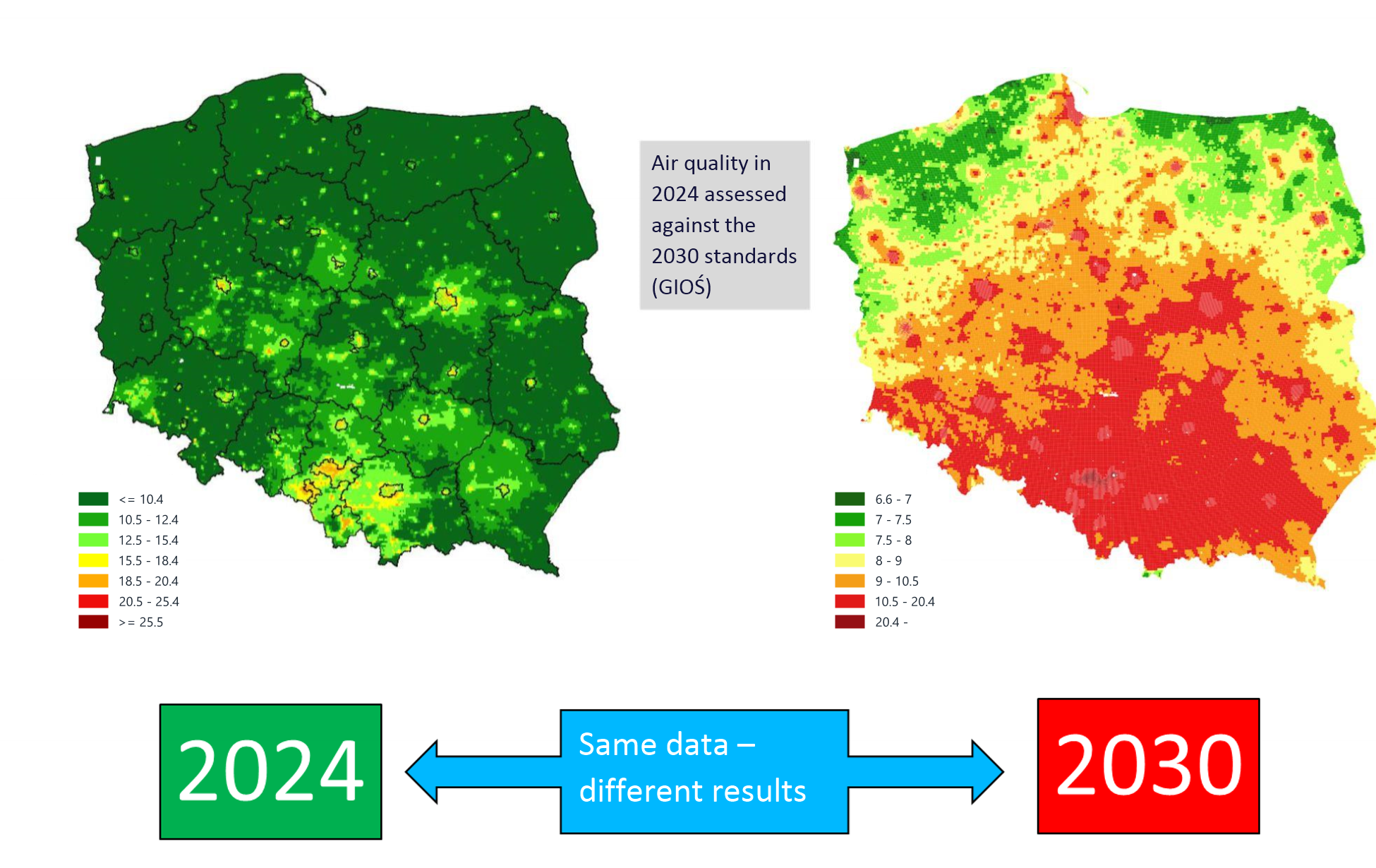
How the assessment of air quality in Poland is changing
The same 2024 PM2.5 data (µg/m³) assessed against the current standards (green map) and against the standards applicable from 2030 (red-and-orange map).
Electromobility alone will not solve the problem
Electric buses, up to seven tonnes heavier, generate more dust from tyre wear and from faster deterioration of the road surface. True, they have no exhaust pipes — but the same harmful substances are released into the atmosphere through the chimney of the power station that produces their electricity. And with Poland's energy mix, CO2 emissions stay at almost the same level. Switching to electric buses also has no effect on the pollution generated by other road users. EXEL, by contrast, reduces the damage done not only by the bus itself, but by any vehicle travelling on city roads. And it turns any public transport vehicle into a pollution vacuum cleaner, regardless of its drive, weight or year of manufacture.
See how EXEL responds to these challenges
Go to technology →
Air purification systems
for all traffic-related pollution.